

Strait is the Gate
Other straits -- a brief tour (May 13, 2026)

‘Enter ye in at the strait gate. For wide is the gate, and broad is the way, that leadeth to destruction, and many there be which go thereat: Because strait is the gate, and narrow is the way, which leadeth unto life, and few there be that find it.’
-- Matthew 7:13-14
A strait, meaning a narrow passage, is always fraught with peril. In classical antiquity, Odysseus was forced to navigate between a six-headed sea monster and a torrential whirlpool in the Strait of Messina between Sicily and Calabria.
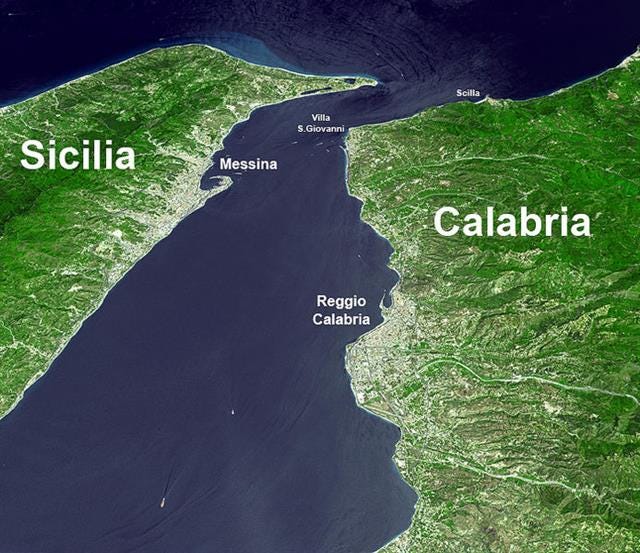
There are no good options, the sorceress Circe tells him — he must either sacrifice six of his men (one for each head of the sea monster) or lose his entire ship in the voracious whirlpool. Odysseus watches in horror as Scylla gobbles up six sailors, but his ship manages to get through the strait.
Further west, we sail through the Strait of Gibraltar — if the Imperial British Navy will permit!
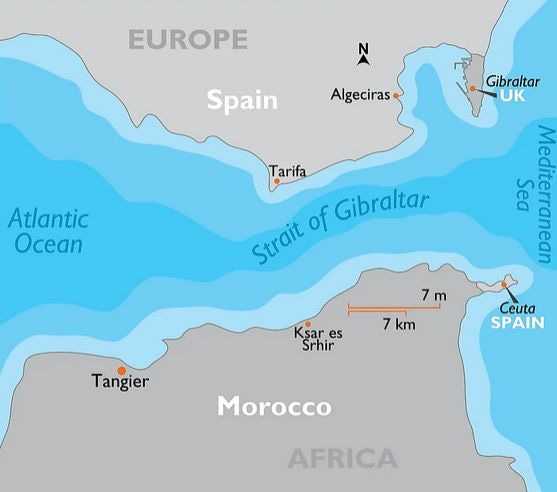
That’s who has controlled the Strait since 1704, when Great Britain captured it from Spain. The American Revolutionary War gave Spain, with France’s assistance, an opportunity, or so they thought, to take it back. Nearly four years of the Siege of Gibraltar, launched in 1779, failed to dislodge the British; they signed a peace treaty in 1783, the same year the United States formalized its independence with another Treaty. The 13-km wide Strait between Europe and Africa had enabled the Moorish capture of Spain, which became the Caliphate of El Andaluz from 1160 to 1462 (with minor interruptions). Passage through the Strait from the Mediterranean Sea to the Atlantic Ocean links the Old World and the New, a transit of immense importance to both trade and conquest. With the opening of the Suez Canal in 1869, the maritime route from the Mediterranean became global. Today Gibraltar remains in British hands by Treaty ‘in perpetuity’, despite occasional claims by Spain.
In the Far East, as it is known in the West, lies the Strait of Tsushima, a narrow passage between Korea and Japan.
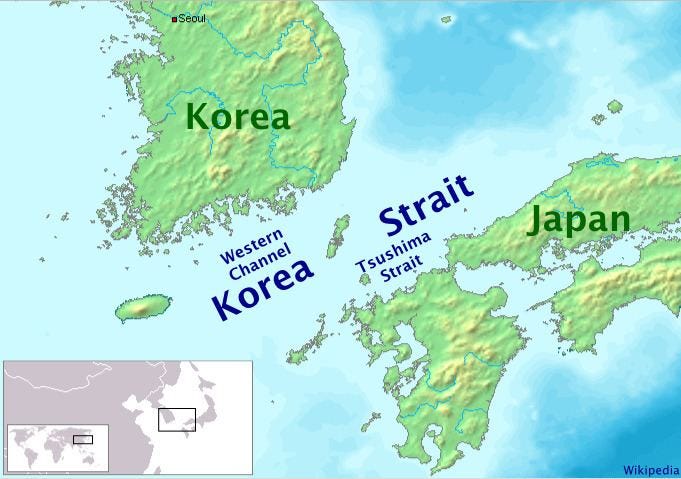
There, in 1905 an exhausted Russian fleet arrived from the Baltic, apparently unaware that Mongol invasions in 1274 and 1281 had been routed from that same area. In 1905, the Japanese Navy waiting for them inflicted devastating losses, the first defeat of a Western power by an Asian one. It set Japan on a triumphal course of imperial expansion that soon turned disastrous, and it was the prelude to the elimination of the Romanov Dynasty by the Bolsheviks a little more than a decade later. The loss of Russia’s Baltic Fleet in the Strait of Tsushima continues to haunt Russian naval authorities today, as they cling to islands between Sakhalin and Hokkaido to protect another strategic strait there (La Pérouse). The Strait of Tsushima remains a vital strategic passage for Japan, through which 90 percent of its oil is imported. Tsushima is also the site of the popular action-adventure video game ‘Ghosts of Tsushima’, and of the world’s northernmost coral reef.
Now we sail northeasterly to... the Bering Strait between Alaska and the Siberian province of Chukotka.
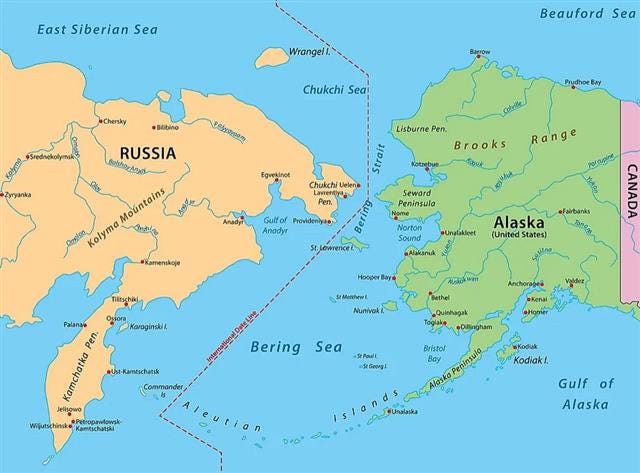
It is named for Danish-Russian explorer Vitus Bering, who sighted Alaska in 1741, though he was actually not the first to do so. At least one Russian preceded him, and presumably the Inuits and Aleuts who lived there saw it first. A land bridge, also named for Bering, connected the two continents during previous Ice Ages, leading to crossings from Asia to North America by humans and other animals. Did the flow go the other way too, or was America even in prehistoric times a big draw for immigrants? Bridge or tunnel links across the Bering Strait are occasionally proposed, then abandoned for cost and logistical reasons. Even so, the Bering is the most peaceful Strait on this tour, and could become a major trade route if, due to global warming or whatever, the Arctic were to become navigable.
The most troublesome Strait at the moment, Hormuz, seems to resemble the choice offered Odysseus, of dealing with a six-headed monster, which, as soon as the six heads are slain, grows another six. It is, however, preferable to getting sucked into the maelstrom of global economic chaos and depression. Decarbonization has become strangely unfashionable of late, ever since tech-oligarchs discovered their AI-equipped data centers will soak up enormous amounts of energy. Yet in 1974, reduction of energy consumption by as much as 20 percent, in response to OPEC’s oil embargo and quadrupling of oil price, was considered feasible. Maybe we don’t need those data centers after all.
Strait and narrow…
I am writing a thank -you, before I have time to read this post of May 13, 2026, in its entirety. But so far, I have looked at every map !
Thanks for this objective thoughtful post.